What Land Clearing Means and What It Includes
Land clearing covers six jobs, and a given lot needs two to four of them: mulching the brush, felling the trees, grubbing the stumps, trucking what will not chip, rough grading, and controlling what grows back. Trees and other vegetation come off; the topsoil stays. Clearing a plot of land for a house is all six. Clearing away honeysuckle under maples so you can use the land is one. Land clearing is essential before any pad, septic field or driveway, because a footer on roots is a crack in five years.
What it is not: tree removal services for one oak over the garage, demolition, concrete, wells or septic. A land clearing company sells land clearing services by the acre and the day; a tree service works by the tree. Clearing services for a land clearing project here mean brush and tree removal in one pass. Land clearing can also mean land preparation on a farm, pasture back from multiflora rose, and the field keeps its CAUV classification. The land clearing process on a lot here starts the same way every time: a walk, a photo into the brush at eye level, and a count of the dead ash.
Land Clearing Methods: Mulching, Grubbing, Pushing, Hand Clearing, Burning
Five methods, and choosing the right method depends on what the ground is for next. Forestry mulching grinds trees and brush to 12 inches into chips in one pass and leaves the roots; it is the cheapest method of land clearing for anything that stays brush or lawn, $1,200 to 2,600 an acre here, and effective for removing light brush and thick brush alike. Grubbing pulls stumps and roots with an excavator, $160 an hour, where a slab goes. Pushing with a bulldozer piles everything for trucking at $600 to 1,100 a load. Hand clearing with saws is manual labor: cut down trees one at a time, selective clearing of a few specific trees or a fence line. Burning is the fifth and in this state mostly a story.
Open burning is out inside every corporation limit. Outside one, land-clearing waste burns only more than 1,000 feet from a neighbor's house, with written notice to the state EPA district office, and never between 6 a.m. and 6 p.m. in March, April, May, October and November under the ODNR Forestry rule. The risk of the fire spreading in a dry April is the reason, and it is important in areas where houses sit under 1,000 feet apart. Translation for a lot owner: mulch or truck. Effective land clearing here is the mulcher in winter and the excavator in June. Tell me what goes on the ground and the method picks itself.
Equipment Used: Mulchers, Skid Steers, Dozers, Excavators, Rotary Cutters, Stump Grinders
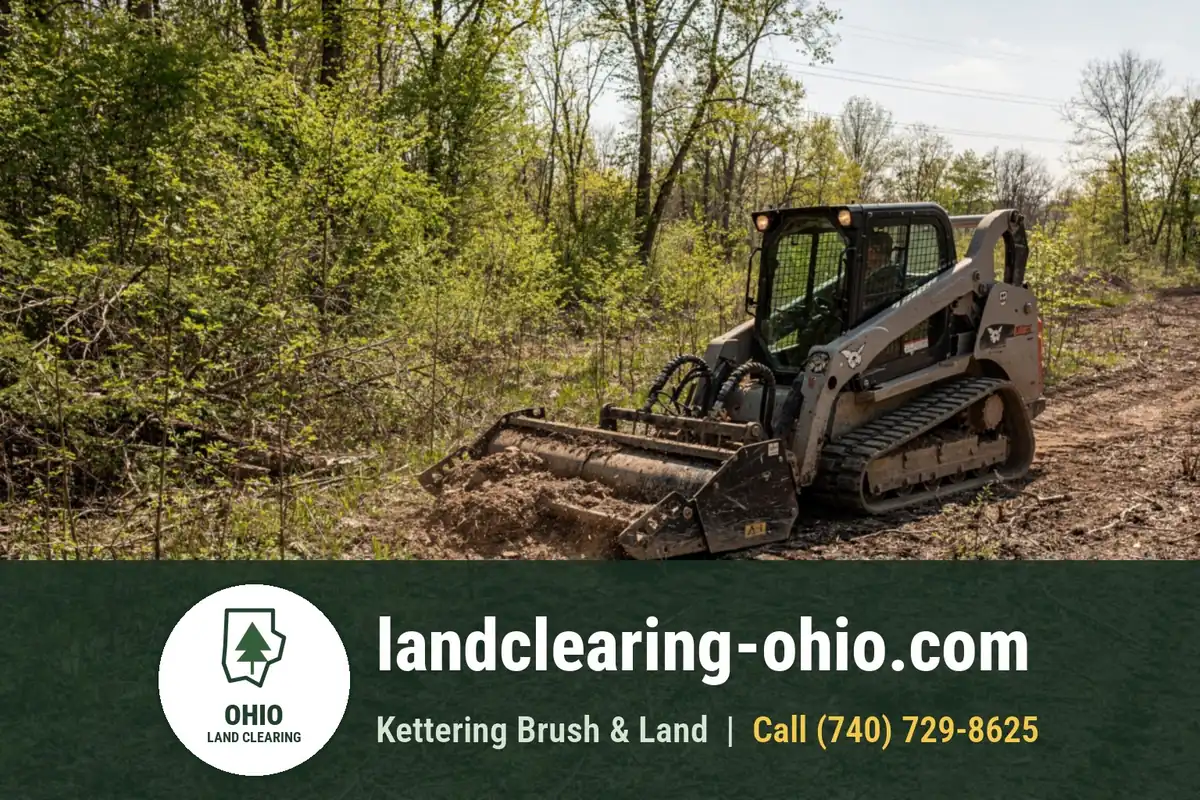
Heavy machinery for clearing is six machines. Forestry mulchers on a skid steer take stems to 8 inches and cost $2,500 a day; a dedicated 300-hp carrier takes 12 inches at $3,900 a day plus transport. Bulldozers and excavators push and grub, $160 an hour with operator. A rotary cutter behind a tractor holds reclaimed ground open for $60 to 90 an acre. A stump grinder finishes a stump at $4 an inch.
The specialized equipment detail that matters on this clay: a tracked mulcher rides frozen ground in January without a mark, and a dozer in April cuts ruts a foot deep in Crosby silt loam. That is why the machinery runs mulching all winter and dirt all summer. Access for construction vehicles comes after us; a 36-inch gate and a wet lane add a day. Send a photo from the road showing the gate and I tell you which machine fits.
Residential, Commercial and Agricultural Clearing
Three kinds of clearing, three rule sets. Residential land clearing is the half-acre township lot for a house, one day, $2,500, with county building approval and a township zoning certificate for the pad. Commercial clearing is the pad or warehouse site, site preparation at scale, where 1 acre or more of disturbance brings the state construction general permit and a stormwater plan the county SWCD reviews. Residential and commercial lots clear the same way; the paperwork differs.
Agricultural clearing is the fencerow and pasture reclaim, and agriculture is exempt from township zoning under ORC 519.21. Land for farming that goes back to hay keeps CAUV. Fifteen acres of fencerow in Knox County, multiflora rose and autumn olive, took three days with the 300-hp machine, $11,700 plus transport. Land for agriculture clears after harvest and before planting, on frozen ground when we can get it. Preparing land for hay is a land use the township cannot zone. Clearing for agricultural purposes needs no permit; a pad on the same ground does. Tell me which of the three you are and I tell you the paperwork.
Do You Need a Permit to Clear Land in Ohio?
No, not for the clearing itself on acreage, and yes for five things around it. A pad needs county building department approval plus a township zoning certificate. An isolated wetland pocket needs an Ohio EPA filing: Level 1 up to half an acre of Category 1 or 2, Level 2 to 3 acres, Level 3 above that or any Category 3. A stream or connected wetland goes to the Corps under Section 404, Huntington District south of the divide and Buffalo District on the Lake Erie side. One acre or more of disturbance brings the NPDES construction filing and the SWCD plan. Columbus, Hudson, Dublin and New Albany have tree rules on some lots.
Two more that are not paperwork but bind you anyway. Trees over 3 inches on a wooded tract over 1 acre come down October 1 to March 31 for the Indiana bat, or you pay for a USFWS survey. OUPS 811 marks utilities 48 hours before any grubbing. Need to clear land and not sure which apply? Clearing requires careful reading of those five, and certain types of lots carry all of them. Send the form with photos or call (740) 729-8625. I email you a budget range and two dates before the end of the day, with the paperwork line above the price.
What Counts as a Wetland on Your Lot and Who Decides
A wetland on an Ohio lot is usually a low corner on Kokomo flats, a vernal pool in the woods, or lake-plain wet woods up north that hold water into May. ORAM is the state scoring method, and a delineation happens before any machine touches the wet spot. The state EPA decides on isolated wetlands; the Corps decides on anything connected to a stream. Fill triggers the filing, not clearing: mulching the honeysuckle over a wet pocket is fine, grading it is not.
The 2-acre creek-bank lot in Loveland carried a Level 1 filing I handled with the owner. A day and a half of mulching, $4,100, and a filing that cost a week, not money. Habitat for wildlife in a vernal pool is why the rule exists, and it is a cheaper way to protect the environment than a fine. Send a photo of the low spot after a rain and I tell you whether it needs a look.
Does Clearing Land Add Property Value?
A lot you can walk sells and a thicket does not; that is the value in one sentence. A dry pad site you can see, dead ash gone, honeysuckle mulched to usable ground under the oaks: the appraisal moves more than the $2,500 a half acre costs. Land development on a subdivision starts with that walk. On a farm the value is the hay check and the CAUV line. Extensive land that sat in callery pear for 15 years becomes room for new pasture in three days; let it overgrow five more and it is a woodlot.
What does not add value: clearing to bare dirt where nothing is going. Bare clay washes, soil erosion fills the county ditch, and the lot looks worse by August. Targeted clearing, the understory out and the crop trees kept, holds value and holds the ground. The environmental impact of a mulched lot is a chip layer and a woodlot that breathes; the environmental impact of a bulldozed one is a silt plume. Add the dead ash count to your photos and I tell you which you have.
What Happens After Clearing: Mulch, Seeding, Regrowth, Grading, Building
The chip layer is 2 to 4 inches deep and holds the clay through spring rain; seed through it in April and the grass comes. Honeysuckle is a shrub that resprouts from the crown, callery pear suckers from the roots, so the regrowth control is three steps: crown ground flush, cut-stump treatment on the pear within minutes, a second winter pass the next year at about a third of the price. A bush hog once a year in late August keeps it after that; proper land management techniques are mostly knowing the date.
Dirt follows clearing by a season on a build. Mulch in winter, grub and grade in June when the clay compacts, pad and footer after that. Erosion control measures, silt fence and a stone entrance, go in at 1 acre of disturbance. Land and preparing it for a house is a two-season job; land clearing necessary for a woodlot you just want to walk is one. Certain types of vegetation, honeysuckle first, come back if you skip the second winter; we remove trees once and the honeysuckle twice. The ecosystem under the oaks comes back faster than you expect once the honeysuckle is off it. Resources for future generations is the extension office's phrase; mine is a woodlot your kids can walk.
Get a Free Estimate
Send the form with photos or call (740) 729-8625. I email you a budget range and two dates before the end of the day, and within 60 miles of Delaware or Lebanon I walk the lot for a free on-site estimate. Two photos help most: one into the brush at eye level, one from the road showing the gate. The size of the area to be cleared, the thickness, and the dead ash count set the number; depending on the location, a transport line. Professional land clearing from one hand, insured crews, and the state's paperwork named before the price. Build a new house, a hay field or a trail, and know what the ground wants first. Clear the land once, the right way, and you clear land again only where the honeysuckle seeds in.