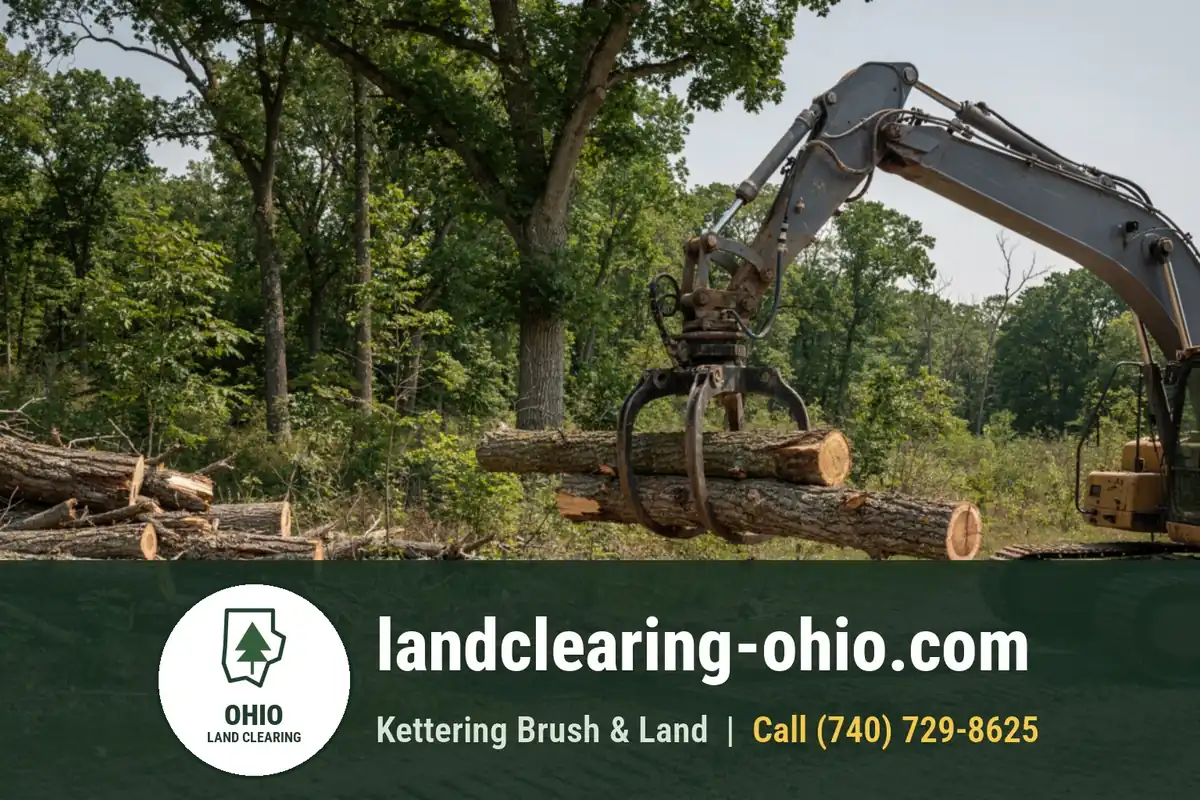
Land Clearing Methods for Removing Trees: Mulching, Felling, Pushing, Grubbing, Stump Grinding
Five land clearing methods, by tree size. Mulching takes a tree to 8 inches on the skid steer and 12 on the 300-hp machine, in one pass, chips left. Tree felling with a saw handles anything bigger; the trunk is bucked and the top is mulched. Pushing with a dozer takes a tree out with its ball, which is right for a pad and wrong for a yard. Grubbing at $160 an hour with operator pulls what pushing left. Stump grinding at $4 an inch finishes a tree you cut flush.
Which method depends on what the ground is for. A woodlot you want to keep: mulch the understory, fell the dead tree, leave the rest. A pad: push, grub, haul. A fencerow: mulch everything to 12 inches. Specialized equipment and heavy equipment both ride frozen ground best, December to February, which is also the Indiana bat window. Burning is out inside corporation limits, so what does not chip gets a haul away at $600 to 1,100 a load. See the per-acre numbers below. Tell me what the ground is for and I pick the method.
Tree Removal and Land Clearing in One Job, Not a Tree Service by the Tree
One crew, one trailer, one invoice. Professional land clearing removes the honeysuckle, the small trees and the dead tree in the same week, and the stump grinding follows the same trailer. A tree service company does one tree at a time with a climber and a chipper; a tree removal service charges by the tree, $800 to 2,500 each in this state, which is right for a maple rubbing against the house and wrong for 40 of them on an acre.
That is why land clearing matters on a wooded lot: the per-tree math breaks past about six. We charge by the acre and the day. A half-acre lot with 15 trees and the honeysuckle under them is one day, $2,500. Residential and commercial lots run the same rate card. Insured crews, general liability and workers comp, and a certificate of insurance in the email if you ask. Lot work and tree work from one hand; concrete, wells, septic and house demolition from people I know. Send photos of the tree line and I tell you where the per-tree price stops making sense.
Dead Ash Removal After the Emerald Ash Borer
Every woodlot in the state has dead ash, and dead ash is a hazardous tree before anyone touches it. Hazardous trees drop limbs in a wind the live ones ride out. The emerald ash borer reached Toledo in 2003, killed statewide 2006 to 2015, and the federal quarantine lifted in 2021. What is left is a standing dead tree with a brittle top. It drops limbs before the saw starts, so the crew fells from the machine, not from the ground, and takes the tree in pieces.
We cleared 6 acres of EAB-killed ash and honeysuckle in Medina County last February on frozen ground. Two days with the 300-hp machine, $7,800. Dead ash is why a mixed woodlot runs $1,800 to 2,600 an acre instead of the $1,200 to 2,000 for honeysuckle alone: a dead tree costs more to drop safely than a live one. Fallen trees already on the ground are cheaper; we chip them where they lie. Storm damage from the 2024 and 2025 outbreaks in Logan, Licking and Clark left a lot of ash on the ground that still needs cleanup. Count your dead ash from the road and send me the number.
Keeping the Oaks, Hickories, Walnuts and Sugar Maples: Tree Work the Arborists Approve
A tree over 6 inches that you point at stays, and the crew tapes it the morning of day one. Selective tree work keeps the white oak, red oak, hickory, black walnut and sugar maple, takes the dead ash, box elder and callery pear, and mulches the honeysuckle between. Mature trees worth keeping are usually a third of the tree count on a central woodlot. The canopy stays; the floor opens.
Some cities decide for you. Columbus requires tree preservation on development sites and Hudson has a tree ordinance; Dublin and New Albany carry landscape codes. In those places a protected tree needs approval for visible tree removal before the trailer arrives, and I check the ordinance before the price. Tree health on the keepers improves when the honeysuckle is gone: more light, less competition. Local tree care after that, trimming and tree pruning, is an arborist's job and we refer it out. Mark your keepers with me on the walk.
Callery Pear, Tree-of-Heaven, Box Elder and Honeysuckle
Four invasive trees and shrubs make up most of the removal work on an old field here. Callery pear lines every I-71 and I-75 field edge; tree-of-heaven takes the gravel; box elder takes the creek; honeysuckle takes everything under them. Each one suckers from the roots or resprouts from the crown. Cut a callery pear and walk away and you have 30 of them by July.
The fix is cut-stump treatment within minutes of the cut, while the sap is still moving. The crew carries the herbicide on the machine and treats as it goes. Honeysuckle gets its crown ground flush and 3 inches of chips on top. Trees and brush like these do not come back if you do both. A 1-acre callery pear thicket in Lebanon took one day plus 9 stumps, $2,500 and $360. Dense brush near a fence you want to keep is hand crew work with a saw, and so is a power line easement the utility wants cleared under. Send one photo into the thicket at eye level and I tell you the tree density.
The Indiana Bat Window: October 1 to March 31 for Every Homeowner With Woods
Trees over 3 inches in diameter on a wooded tract over 1 acre come down October 1 to March 31. That is the USFWS rule for the Indiana bat and the northern long-eared bat, run through the Ecological Services Field Office in Columbus. Outside the window you pay for a summer habitat survey or you wait. On a quarter acre in town it does not apply. On 3 acres of woods it does.
The window matches the frozen ground anyway, so we book wooded tracts December to February first. ODNR Division of Wildlife reviews state-listed species on larger tracts. The homeowner who calls in May with 5 acres of woods hears the same thing from me every year: October, or a survey. Taking a tree over 3 inches in June on a wooded tract is a federal problem, not a Royce problem. Send the acreage and the tree size and I tell you if the window applies.
Stump Grinding vs. Stump Removal After Safe Tree Removal
We offer stump grinding at $4 per inch of diameter, $150 minimum, and full stump removal with the excavator at $160 an hour. Grind where grass or a driveway goes: the stump goes 6 to 10 inches under and the roots rot in 5 to 8 years. Remove where a footer or a septic field goes, because a rotting root under a slab is a void. Ten or more stumps are a day, not a per-stump sum.
On a mulched woodlot the stump is already flush and most owners leave it. On a pad the bucket pulls the ball with the brush removal and it leaves in the same load. Debris removal of the grindings is a load, $600 to 1,100, or they fill the hole and the surplus goes on the beds. Tell me what goes on top of each stump and I tell you grind or pull.
Tree Clearing Cost per Acre: See Land Clearing Cost in Ohio, Free Quote
Mixed woodlot with dead ash, $1,800 to 2,600 per acre. Full tree removal to dirt with stumps out, $2,800 to 5,000 per acre. Honeysuckle and saplings alone, $1,200 to 2,000.
- Skid steer mulcher: $2,500 a day, transport included within 60 miles of Delaware or Lebanon. Trees to 8 inches.
- 300-hp mulcher: $3,900 a day plus transport. Trees to 12 inches.
- Quarter acre: $1,700 flat. Half acre: one day, $2,500.
- Felling over 12 inches: by the day, with the mulcher chipping the tops.
- Stump grinding $4 per inch. Grubbing $160 an hour. Haul-off $600 to 1,100 a load.
What a commercial tree outfit charges for one tree, we usually cost for a tenth of an acre. Frozen ground, no surcharge; mud season adds a day or we wait. The 3-acre honeysuckle woodlot outside Sunbury with its dead ash ran a day and a half, $3,800. Free quote by email, free on-site estimate within 60 miles of a yard. Call (740) 729-8625 or send the form with photos. I email you a budget range and two dates before the end of the day.
Where We Clear Trees: Land Clearing Near Homes and on Acreage, and the Local Tree Removal Service We Refer
Transport is included within 60 miles of Delaware or Lebanon: Columbus, Dayton, Cincinnati and the counties between. Cleveland, Akron, Canton and Toledo carry a transport line from Delaware. Clearing beside a subdivision home runs the same rate as a farm woodlot; access for equipment is what changes the day count. A 36-inch gate and a 50-foot backyard is a skid steer job. A tree between the house and the neighbor's fence is climber and crane work, which we refer to a local tree removal outfit.
What we are not: an emergency tree removal service, a free tree service, arborists, or a tree trimming crew. Tree trimming and pruning on the keepers, trimming a limb over the roof, and prune work on an orchard go to ISA certified arborists; they prune, we remove trees. Professional tree work on one trunk is theirs. We prepare land for construction and clear the woodlot you cannot walk. Property maintenance after that, a bush hog once a year, is on our bush hogging page. Honeysuckle and saplings are the bulk of our clearing jobs; dead ash is the rest. I have run them since 2018, on frozen ground when I can get it. Send the form with photos or call (740) 729-8625 for a budget range before the end of the day.