Underbrush Clearing: Honeysuckle Out, Oaks and Small Trees Kept
Underbrush is the honeysuckle, grape vine and thick undergrowth under a woodlot you cannot walk through. We take it out at $1,800 to 2,600 an acre and leave every oak, hickory, walnut and sugar maple. The drum cuts the honeysuckle crown flush. That is the operator detail that matters: honeysuckle resprouts from the crown, so a cut six inches up is a pruning, not a clearing.
The mulch layer runs 2 to 4 inches and holds the clay through April. Dead ash comes down first because its top drops before the trunk is touched. On a woodlot in Sunbury we did 3 acres in a day and a half, $3,800. Send a photo at eye level into the woods and I will tell you the density class.
Clearing, Removal and Land Management: The Difference
Clearing means we grind it where it stands. Removal means it leaves in a truck at $600 to 1,100 a load. Land management means you keep it from coming back. Most lots inside a corporation limit get the first, because burning is out under the Ohio EPA open burning rule, and hauling chips is money spent twice.
Brush removal by truck is for debris that will not chip: fence wire in the thicket, a dumped pile, trunks over 12 inches. Land clearing services to dirt, with stumps out, is a different price. Land-clearing of any kind starts with the same walk. I tell you which of the three you are buying before the number.
How to Clear Brush: Bush Hog, Forestry Mulcher, Grubbing, Chainsaw Crew and DIY Tools
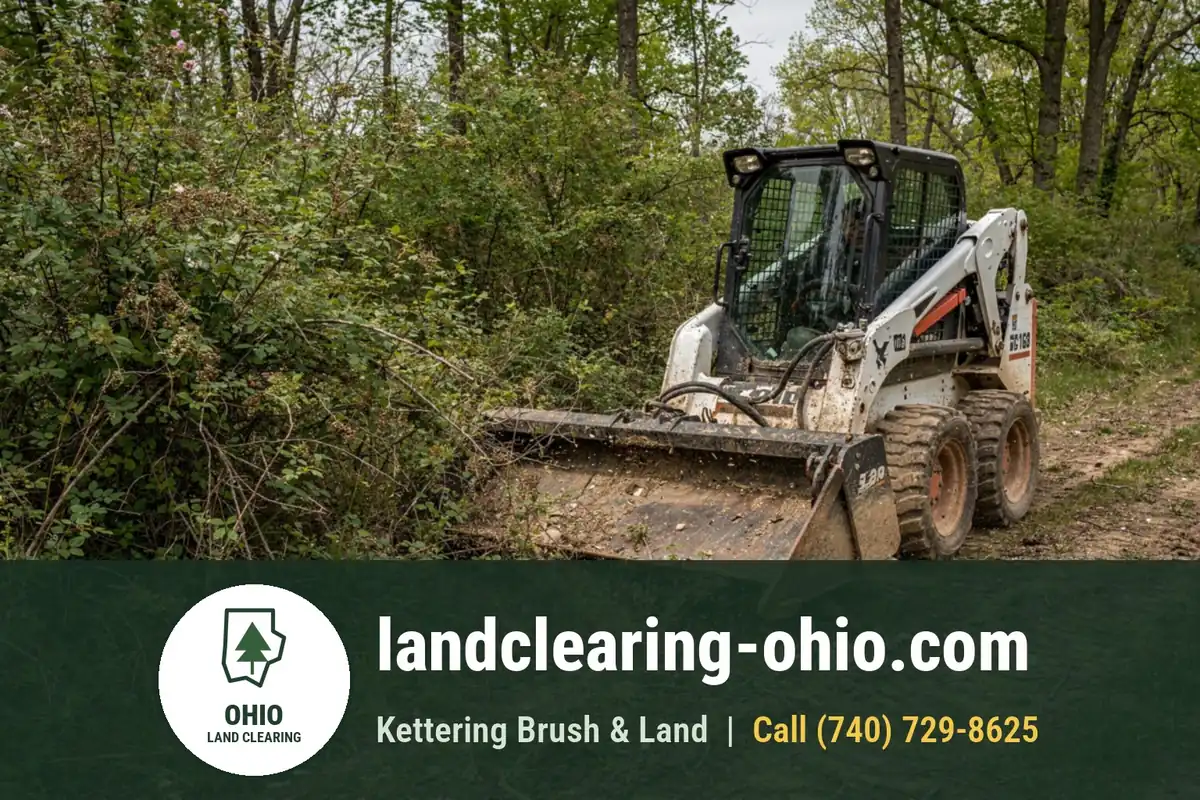
Four methods, by stem size. A bush hog behind the tractor handles stems under 2 inches, goldenrod, fescue and small saplings, $60 to 90 an acre. The forestry mulcher takes stems to 8 inches on the skid steer and 12 on the 300-hp machine. Grubbing with the excavator at $160 an hour pulls the roots where a pad goes. A hand crew with a chainsaw and herbicide on the fresh cut handles callery pear along a fence you want to keep.
The DIY tools for clearing brush, a walk-behind cutter, a blade on a string trimmer, a mower with a mulching deck, work on a backyard and fail on an acre. Backbreaking, and the crown stays alive. Type of equipment follows density: dense brush you cannot see through is brush-clearing equipment work, every time. The tools and equipment we bring are insured and so are the crews. Send the photos and I pick the machine.
Honeysuckle, Multiflora Rose, Autumn Olive, Callery Pear and Buckthorn by Region
Honeysuckle is everywhere and worst around Cincinnati, where the ravine lots carry the thickest stands in the state. Callery pear lines I-71 and I-75 on every old field. Multiflora rose and autumn olive own every pasture that missed five years of mowing. Buckthorn fills the wet thickets from Lorain to Medina. Tree-of-heaven takes the gravel along the Great Miami.
Each one gets a different cut. Honeysuckle: crown flush, chips on top. Callery pear and the heaven tree: herbicide on the stumps within minutes of the cut or every root suckers by July. Rose and olive: mulch in winter, second pass the next winter. Buckthorn: mulch when the muck is frozen. Overgrown vegetation here is a mix of those five. Name your county and I will tell you which two you have.
Selective Clearing: Keep the Oaks, Remove the Honeysuckle and Dead Ash, Leave Usable Ground
Selective clearing on a woodlot keeps every tree over 6 inches you point at and takes everything else. The crew flags the keepers with tape the morning of day one. The mulcher works between them; the dead ash is felled first, and the honeysuckle, vine and small trees go to chips. The land’s appearance changes in a day; the crowns above do not. A landscape you can see into, with the soil still under the roots.
Trees over 3 inches on a wooded tract over 1 acre are cut October 1 to March 31 for the Indiana bat, unless a USFWS survey clears the site. Selective work fits that window. The result is a healthier woodlot, more light on the floor, fewer fire hazards, one less hazard from dead ash, and the usability of ground you can walk. Mark the keepers with me on the walk.
Pasture Reclamation and Fencerow Clearing on the Farm
Fifteen acres of fencerow and pasture reclaim in Knox County took three days with the 300-hp machine, $11,700 plus transport. Multiflora rose and autumn olive had taken the fence lines 40 feet wide. The field went back to hay that summer and kept its CAUV classification.
Autumn olive is the one shrub in Ohio that likes being mowed. Mow it and it thickens; grind the crown and leave the chips and it quits. Clearing overgrown pasture runs after harvest in late October and before planting in April, on frozen ground when we can get it. NRCS EQIP is a cost-share program a landowner can apply for. Preparing land for hay again is a three-day job, not a three-year one.
Fence Line, Trail, Creek Bank and Ditch Clearing Through Dense Vegetation
A fence line clears at about a quarter mile a day with the skid steer, both sides. Trails run a half mile a day through honeysuckle. Creek banks keep their roots: we mulch the top and leave the bank, because a grubbed bank washes in the first heavy rain and the erosion is yours. A county ditch gets cleared to the maintenance strip and never blocked.
Standing water in a thicket gets an ORAM look before a machine goes in. A wet pocket under half an acre is an Ohio EPA Level 1 isolated wetland permit, filed with you. Terrain and access set the day count more than acreage here. Send a photo from the road and I will tell you if the skid steer reaches it.
Why Honeysuckle Comes Back and How Our Service Slows It
It comes back from the crown and from seed. Honeysuckle regrows from a crown left an inch high. Callery pear suckers from every root you cut, and a sapling is a stump-sprout by August. Rose and olive seed in from the fencerow birds. Let overgrown land overgrow one more year and the overgrowth doubles. The fix is three steps: grind the crown flush, treat the pear stumps in fall within minutes of the cut, and leave 3 inches of chips to starve the seedlings.
A second pass the next winter runs about a third of the first price and gets the escapes. After that a bush hog once a year in late August keeps it clear; our bush hogging page covers that. Minimize the disturbed ground and the desired vegetation fills in. The nutrient from the chips feeds the grass you seed in April, and weed pressure drops every year the ground stays covered.
Brush Clearing Cost per Acre in Ohio
Honeysuckle and scrub mulching runs $1,200 to 2,000 an acre by density. Woodlot understory under crop trees runs $1,800 to 2,600.
- Skid steer mulcher: $2,500 a day, transport included within 60 miles of Delaware or Lebanon.
- 300-hp mulcher: $3,900 a day plus transport. Stems to 12 inches.
- Bush hog maintenance: $60 to 90 an acre, $400 minimum.
- Haul-off of what will not chip: $600 to 1,100 per load.
- Stumps where a pad goes: $4 per inch, $150 minimum each.
Frozen ground, no surcharge. Mud season adds a day or we wait. Half an acre is one day, $2,500. Call (740) 729-8625 or send the form with photos. I email you a budget range and two dates before the end of the day. Free on-site estimate within 60 miles of a yard.
Where We Clear Honeysuckle Near You
Transport is included within 60 miles of Delaware or Lebanon: Columbus, Dayton, Cincinnati and the counties between. Cleveland, Akron, Canton and Toledo carry a transport line from Delaware. Clearing land of honeysuckle costs the same in every county; only the transport line moves. Professional brush clearing services on a lot improve curb appeal and property value the week they happen. Forestry mulching on a farm improves the hay check the next summer. Many benefits from one machine, one service.
I have cleared honeysuckle since 2017 and run this land clearing company full time since 2018. The crew makes a lot safer, more functional and usable, removes the obstacle between you and your own back forty, and the aesthetics take care of themselves. We restore ground; we do not landscape it. Send the form with photos or call (740) 729-8625 for a budget range the same day.