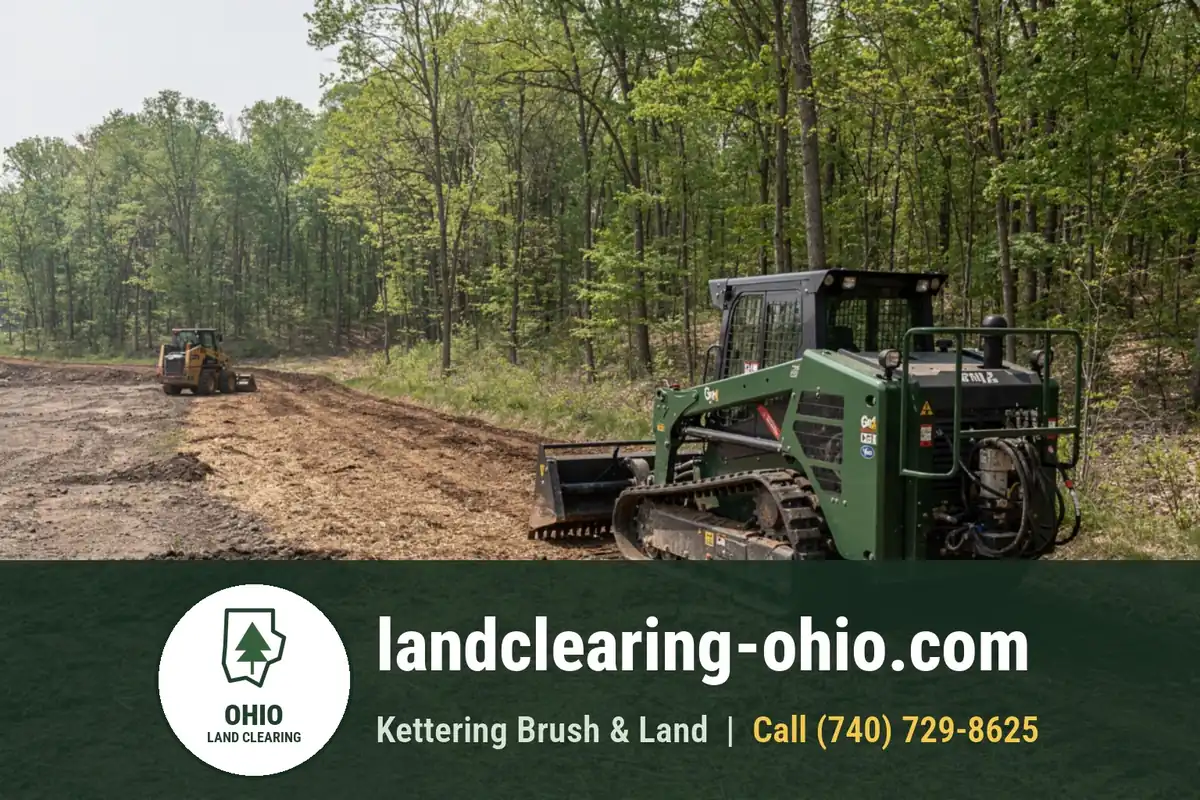
How Each Method Works
A forestry mulcher is a spinning drum fitted with steel teeth on the front of a skid steer or a 300-hp track carrier. It grinds everything standing, brush and small trees to 8 or 12 inches, into wood chips in a single pass and lays them where the stem stood. Mulching leaves roots in the clay. A one-step process, one machine, no pile, no truck. The mulching head is the whole tool; the carrier just moves it.
A bulldozer pushes. The blade shears the tree, the roots and the topsoil in one shove and piles them. Then an excavator pulls what the blade left, and the pile leaves in trucks or burns where the state allows, which inside a corporation limit is nowhere. Traditional land clearing is three machines and a week of hauling. Unlike bulldozing, mulching does not strip the land bare. Tell me what goes on the ground afterward and the method is picked.
Cost Comparison per Acre and per Day: Forestry Mulcher vs. Dozer
The drum is $2,500 a day on the skid steer, transport included within 60 miles of Delaware or Lebanon, or $3,900 a day plus transport for the 300-hp machine. That lands at $1,200 to 2,000 an acre for honeysuckle and $1,800 to 2,600 for a woodlot with dead ash. The dozer and excavator run $160 an hour with operator, and the haul-off runs $600 to 1,100 per 10-yard load. Clearing to dirt with stumps out lands at $2,800 to 5,000 an acre, because an acre of woodlot generates 10 to 15 loads.
Three acres of honeysuckle woodlot outside Sunbury: a day and a half of mulching, $3,800. The same three acres bulldozed to dirt would have run $10,000 to 14,000 with the trucking. Mulching is faster and about half the money wherever the roots can stay. Bulldozing is the right money where a slab goes. Send the photos or call (740) 729-8625 and I price both lines in the same email.
Speed: Acres per Day, Mulch vs. Push
The skid steer clears half an acre to a full one a day in honeysuckle; the 300-hp machine clears 3 acres on open fencerow and 1 to 2 in a woodlot with larger trees. Density sets the pace: a thicket you cannot walk through drops the skid steer to three quarters of an acre. A dozer pushes an acre of woodlot in a day too, but the acre is not done. The excavator to pull the stumps is another day, the loader and trucks are two more, and the cleanup after the trucks is a fourth.
So the honest count is one machine-day for a mulched acre and four for a bulldozed one, with the labor of multiple operators on the second. On frozen ground in Medina County last February the 300-hp machine did 3 acres a day of dead ash and honeysuckle, land cleared with no dozer on it; no dozer moves in February clay at all. Tell me the acres and the thickest stem and I give you the days.
What Happens to the Debris: Mulch Layer vs. Burn Piles vs. Haul-Off
Mulching leaves a layer of mulch 2 to 4 inches deep and nothing else. Bulldozing leaves brush piles, and in Ohio a pile has three fates. Burning debris is out inside every corporation limit under the Ohio EPA open burning rule. Outside one, land-clearing waste burns only more than 1,000 feet from a neighbor's house, with written notice to the EPA district office, and never 6 a.m. to 6 p.m. in March, April, May, October and November under the ODNR Forestry rule. Translation: most piles leave in trucks at $600 to 1,100 a load, or sit for years.
The chips are organic material that retain moisture through August and feed the clay as they rot, enriching the soil the extension office would say. I say the ground is covered and the honeysuckle seedlings are smothered. Firebreaks on a woodlot edge are a drum job for the same reason: nothing left to burn. Send a photo of the lot line and I tell you what the debris plan is.
Soil, Water and Roots: How to Clear Land on Till Clay, Lake-Plain Clay and Gravel
Till clay under Columbus, lake-plain clay from Lorain to Toledo, and the fragipan under Clermont all perch water a foot down, and that is the whole case for the drum: it rides frozen ground in January without a mark, and the roots it leaves hold the clay when the water comes in April. Soil disturbance from a dozer on that ground is a foot deep, and erosion risks on a bulldozed slope are real until grass takes, which on Ohio clay is June. The chip layer prevents erosion the day it goes down and feeds soil health as it rots; it is the minimal environmental impact option by a wide margin.
The dozer wins when you need the stumps out. A pad, a driveway, a septic field, a pond: roots under any of them are a void in ten years. On a gravel terrace along the Great Miami the dozer works any month and the argument is only about the stumps. Mulching leaves roots; that is a feature on a woodlot and a defect under a slab. Tell me what sits on the ground in five years and the soil answers the question.
Honeysuckle and Callery Pear: Why Neither Clearing Method Leaves the Land Clear Alone
Honeysuckle resprouts from the crown and callery pear suckers from every root you leave, so neither machine finishes the job by itself. The drum grinds the honeysuckle crown flush and buries it in chips, which smothers most of the regrowth. The dozer pushes the crown out but tears the ground open, and callery pear, multiflora rose and buckthorn seed into disturbed clay faster than grass does. Invasive plants love a bulldozed lot, and dense vegetation comes back thicker than what you pushed.
The fix is the same either way: cut-stump treatment on pear and tree-of-heaven within minutes of the cut, chips left thick to suppress the seedlings, and a second winter pass at about a third of the first price. On a woodlot in Delaware County the second pass was a half day. Woody growth that comes back after that is a bush hog once a year. Send a photo into the thicket and I tell you which plant you are fighting.
When You Need a Dozer Anyway, Even on a Forestry Mulching Lot
Five jobs need the dozer or the excavator no matter how good the drum is: the pad, the driveway, the pond, the septic field, and dead ash root balls where a slab goes. Tree stumps under a footer are a crack; the excavator to pull them is $160 an hour and worth it. Site prep for a building site is mulch the lot in winter, grub the footprint in June. Storm damage with fallen trees across a lane is a dozer and a chainsaw, not a drum. A pipeline or utility easement the company wants to bare dirt is dozer work too, and so is a fence line pushed clear along property lines.
What the dozer is not for: a woodlot you want to keep wooded, a creek bank, a wet corner, or honeysuckle under oaks. Property owners who bulldoze a woodlot for a house pad and then wonder where the shade went call me the next year. Grub the pad, mulch the rest. Tell me the footprint and I draw the line between the pair of them on your plat.
Which Land Clearing Method for Your Lot
Five lots I see every month, and what each one gets.
| Lot | Method | Why |
|---|---|---|
| Honeysuckle woodlot, house going in | Mulch the lot, dozer on the pad | Keep the oaks, roots out only under the slab |
| Pasture reclaim, rose and autumn olive | Drum, then brush hog yearly | Field goes back to hay, CAUV holds |
| Callery pear old field | Mulcher with cut-stump treatment | Dozer disturbance seeds more pear |
| Dead ash woodlot | Mulcher in the bat window | Fell first, grind second, frozen ground |
| Creek-bank lot, wetland pocket | Drum, no fill | Fill triggers the Ohio EPA permit, clearing does not |
Forestry mulching services cover four of the five; the dozer shows up for the pad. A rotary cutter behind a tractor handles the maintenance after. The 2-acre creek-bank lot in Loveland carried an isolated wetland Level 1 filing and got mulched in a day and a half, $4,100, with no dirt moved. Those are the land clearing methods on this site, and the mulcher to clear and the dozer to grub share most lots. Pick your row and send the form with photos or call (740) 729-8625. I email you a budget range and two dates before the end of the day and confirm it on the walk, free within 60 miles of a yard.